Returns after Black Friday: Why return data determines your true Black Week revenue
Black Week revenue appears in every December report. Yet, very few brands know how much of that revenue actually sticks or how many new customers return for a second purchase.
October 30, 2026
By January, management asks why the numbers look so weak. The shop backend, helpdesk, and warehouse list provide three different answers. Marketing has long since allocated its budgets based on gross revenue, and customer service has barely survived December with the help of temporary staff.
At toern, we see this scenario in our client projects year after year. The data exists; it’s just trapped in four different systems and never consolidated. In this article, we show where return data makes the difference in Black Friday business and how brands can make it actionable before Black Week 2026.
Black Week revenue after returns: the figure missing from your reporting
The German Retail Federation (HDE) expected around 5.8 billion euros for Black Friday and Cyber Monday 2025. A large portion of this ends up under the Christmas tree. According to the HDE and IFH Köln, more than half of customers use Black Friday for their Christmas shopping.
This shifts the math. Returns for these purchases arrive only after the holidays, by which time the Black Week reporting has long been presented. Anyone closing their books in December is evaluating campaigns, channels, and discounts based on revenue that, to a significant extent, will be returned.
New customers from Black Week: The return determines the second purchase
No other week of the year brings in as many new customers as Black Week. Data from US marketing provider Bluecore for Black Friday 2024 shows that nearly two-thirds of buyers were new to their respective shops. At the same time, a 2023 analysis by CRM provider Optimove found that first-time buyers from Black Friday are 19 percent less likely to make a second purchase.
For many of these new customers, the return process is their second interaction with the brand—and it’s a deciding one. According to the "The Returns Landscape 2025" study by DHL eCommerce, nearly three-quarters of German online shoppers will not buy from a brand they don't trust when it comes to returns.
Furthermore, a bad return experience doesn't stay private. After a poor return experience, a good two-thirds of customers are less likely to shop with the same retailer again, according to a 2025 report by the US National Retail Federation (NRF) and return provider Happy Returns. Four out of five will tell friends and family about it. The acquisition costs are paid, but the customer lifetime value never materializes. For us, the post-purchase journey is just as much a part of brand management as the campaign that preceded it.
Returns by sales channel: the channel ROAS that almost no one calculates
No week of the year receives as much media budget as Black Week. Campaigns are evaluated based on ROAS and customer acquisition costs. The portion of revenue that comes back as returns is missing from this calculation.
It starts with the costs. More than a quarter of online retailers cannot say what a single return costs, according to the "Shipping, Packaging, and Return Management in E-Commerce 2026" study by the EHI Retail Institute. Without this figure, revenue per channel cannot be adjusted for returns. A channel with strong ROAS and a high return rate will look better on the dashboard than a channel that sells less but retains more.
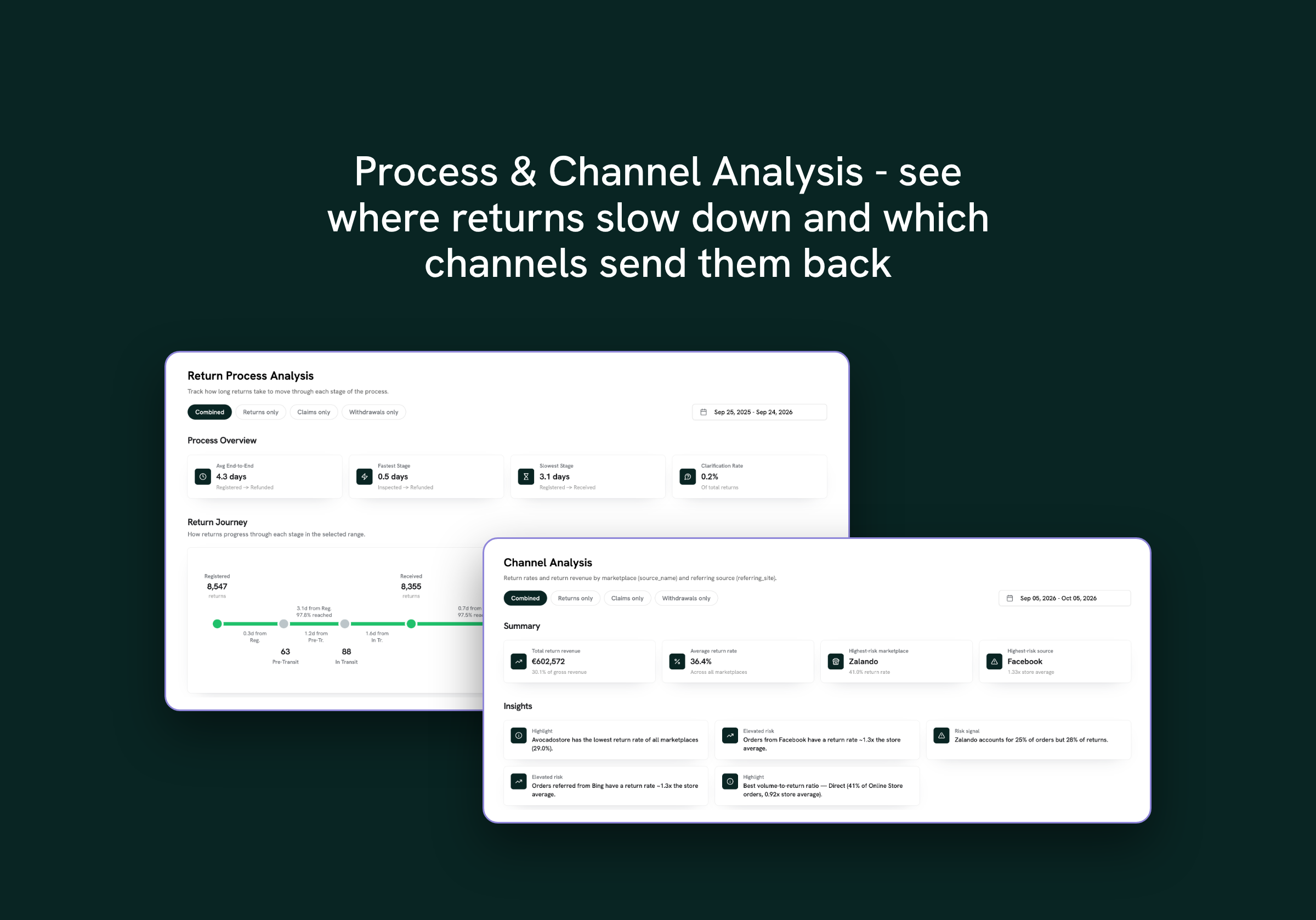
"Marketing and operations are looking at two different numbers," says Alena Schneck, founder and CEO of toern. "Marketing sees revenue per channel; operations sees returns. They are almost never merged. That was the most common request from our clients, which is why we integrated Channel Analysis into our toern tool."
How Channel Analysis works in toern: Our dashboard shows how much is returned from each sales channel. This allows marketing and operations to work with the same data. By tracking returns per channel now, you can allocate 2027 budgets based on channel ROAS minus returns.
The return process during peak season: where time is lost in December
The 2025 report from the NRF and Happy Returns shows just how much of the holiday business is still handled manually: more than four out of ten retailers hire additional staff for returns during the holiday season. In practice, this means ticket volume spikes, "Where is my refund?" becomes the most common question in the inbox, and temporary workers are left holding the customer journey together.
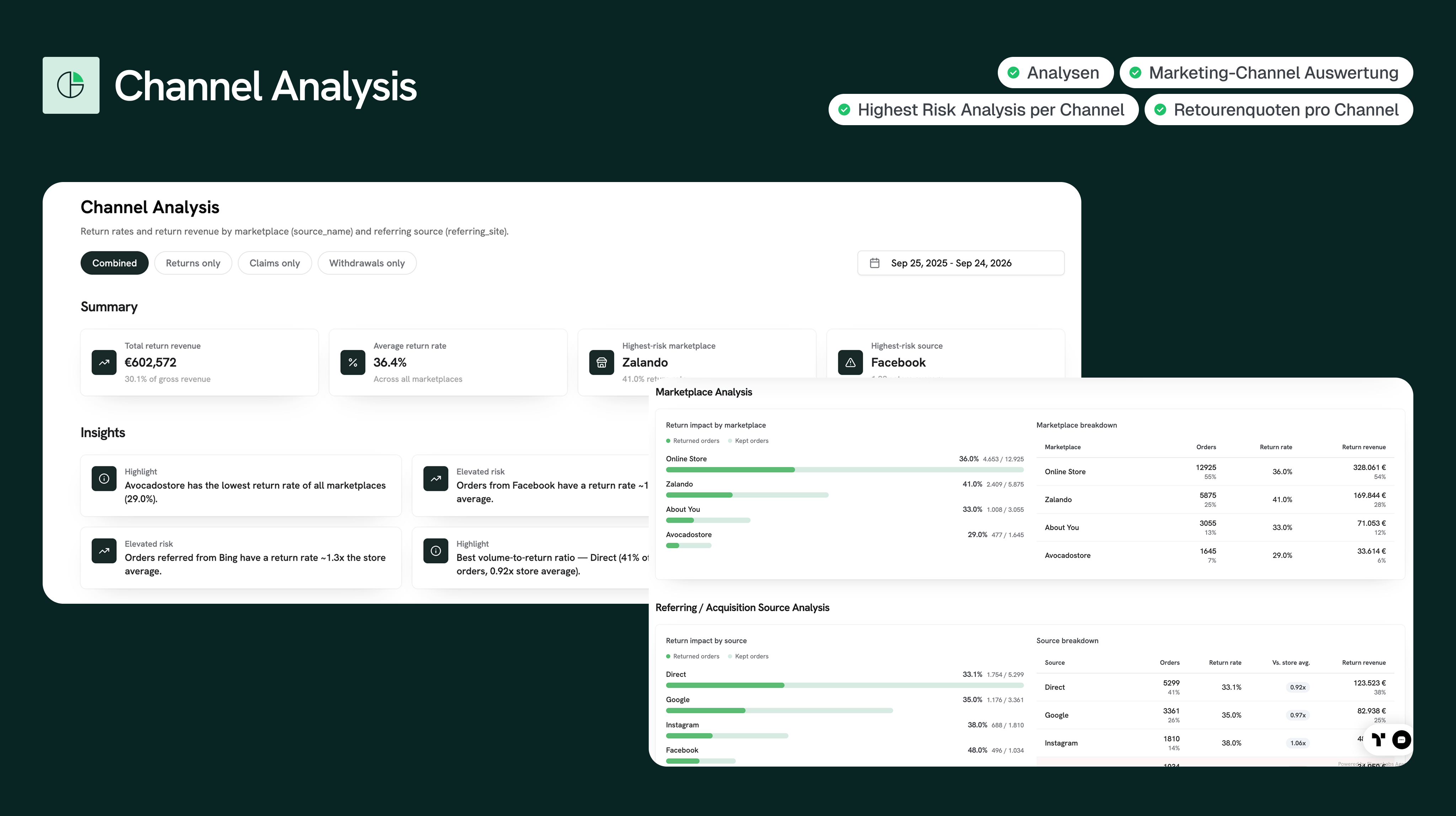
Processing itself also takes time. According to the EHI Retail Institute, more than one in four retailers takes three to four days to process a return. On average, it takes nearly ten days from registration to completion. Very few teams can pinpoint exactly where the time is being lost.
This is how process analysis works in toern: We measure how long each step in the returns process takes, from registration and shipping to goods receipt and refunding. This makes it possible to identify bottlenecks before the wave of returns hits. At the same time, the process itself is automated: customers register returns, cancellations, and complaints in the toern returns portal and receive their return label immediately after registration—regardless of weekends or service hours.
"Anyone who measures how long each step takes and how much is coming back from which channel during this holiday season can still take corrective action in December," says Alena Schneck. "And won't have to plan blindly in 2027."
Exchanges instead of refunds: how brands keep Black Week revenue in-house
Not every return has to result in a refund. According to a 2026 survey by Loop, nearly nine out of ten customers would choose an exchange if it were easy enough. This is exactly where we come in with exchanges and store credit directly in the toern returns portal. During registration, customers can select a different size or store credit instead of a refund. Brands working with toern retain up to 25 percent of their revenue this way.
Checklist: Setting up return data before Black Week 2026
1. Measure lead times for each process step. Before the wave of returns, not after.
2. Track revenue after returns as a key metric. Alongside ROAS and CAC, every Black Week campaign report should include the question of how much revenue remains after returns.
3. Mark Black Week new customers as a separate cohort. By tracking them until spring, you can see which channel acquires customers who buy a second time and which one only attracts discount shoppers.
4. Actively offer exchanges and store credit. Every exchange is revenue that stays in the company.
5. Treat return and exchange emails like campaigns. They are the second point of contact with many new customers and deserve the same standards of tone and design as the ad that preceded them.
6. Get marketing and operations at the same table. A shared metric replaces two dashboards that contradict each other.
7. Don't finalize your Black Week balance sheet until February. Once the holiday returns have been processed, you will see which campaign was truly successful.
Returns management with toern: returns portal, process analysis, and channel analysis in one platform
toern manages the entire post-purchase process for e-commerce brands. Returns, cancellations, and complaints are consolidated in our returns portal, automated and integrated with shop, fulfillment, ERP, and CRM systems. toern is available as an app in the Shopify App Store.
Unlike traditional returns platforms, we make the data from the process actionable:
- Process Analysis: how long each step in the returns process takes
- Channel Analysis: how much is returned from which sales channel
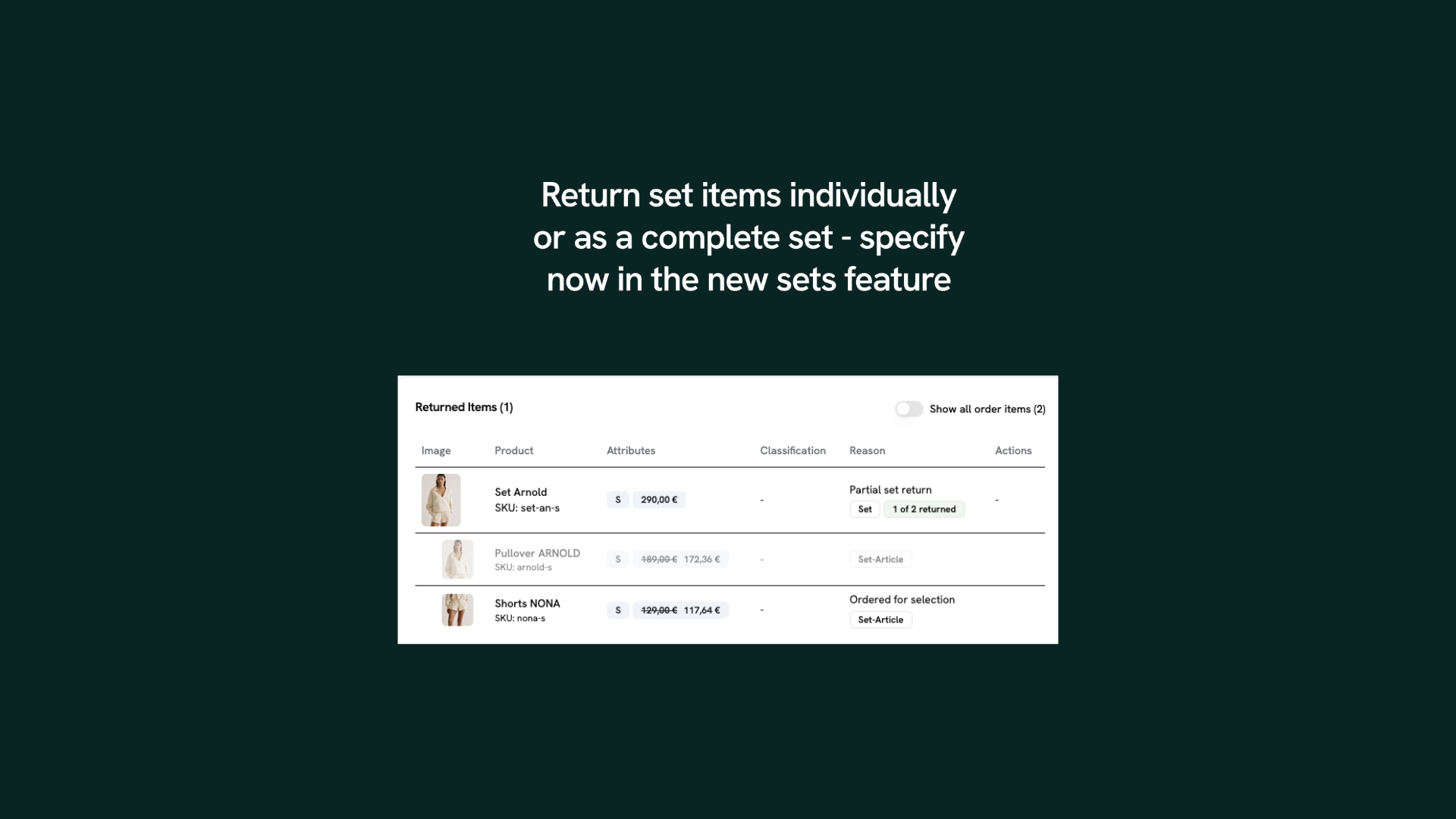
- toern.AI: which items are returned for what reason, aggregated by item and size
- Exchanges & Store Credit: Retain revenue instead of refunding
If you start doing this during this year's holiday season, you won't be planning for 2027 based on the revenue you sold, but on the revenue you actually kept.
Don't just handle returns. Outsmart them.
---
FAQ on post-Black Friday returns
When do the Black Week returns arrive?
A large portion won't arrive until January. According to the HDE and IFH Cologne, more than half of customers use Black Friday for Christmas shopping. The corresponding returns arrive after the holidays. Therefore, a reliable Black Week balance sheet can only be drawn up in February.
How do you calculate channel ROAS after returns?
Subtract the value of returns from that specific channel from the revenue per sales channel, including the cost per return. The result is then set in relation to the channel's media budget. toern's channel analysis provides the return data per channel for this purpose.
Why is return data so important for Black Friday business?
Because nearly two-thirds of Black Friday shoppers are new customers, and the return process is their second point of contact with the brand. Return data shows which channels bring in customers with repeat-purchase potential, where the return process is stalling, and how much revenue actually remains.
What is toern?
toern is a return management platform based in Hamburg. Returns, cancellations, and complaints are processed automatically in a single portal. At the same time, toern analyzes the data: lead times per process step, returns per sales channel, and return reasons per item. toern was founded in 2023 by Alena Schneck and Jonas Zeuner.
Neueste Beiträge
Verfolge unsere News
Entdecke die neuesten Beiträge auf unserem Blog – von Brancheninsights über Events bis hin zu technischen News und mehr.